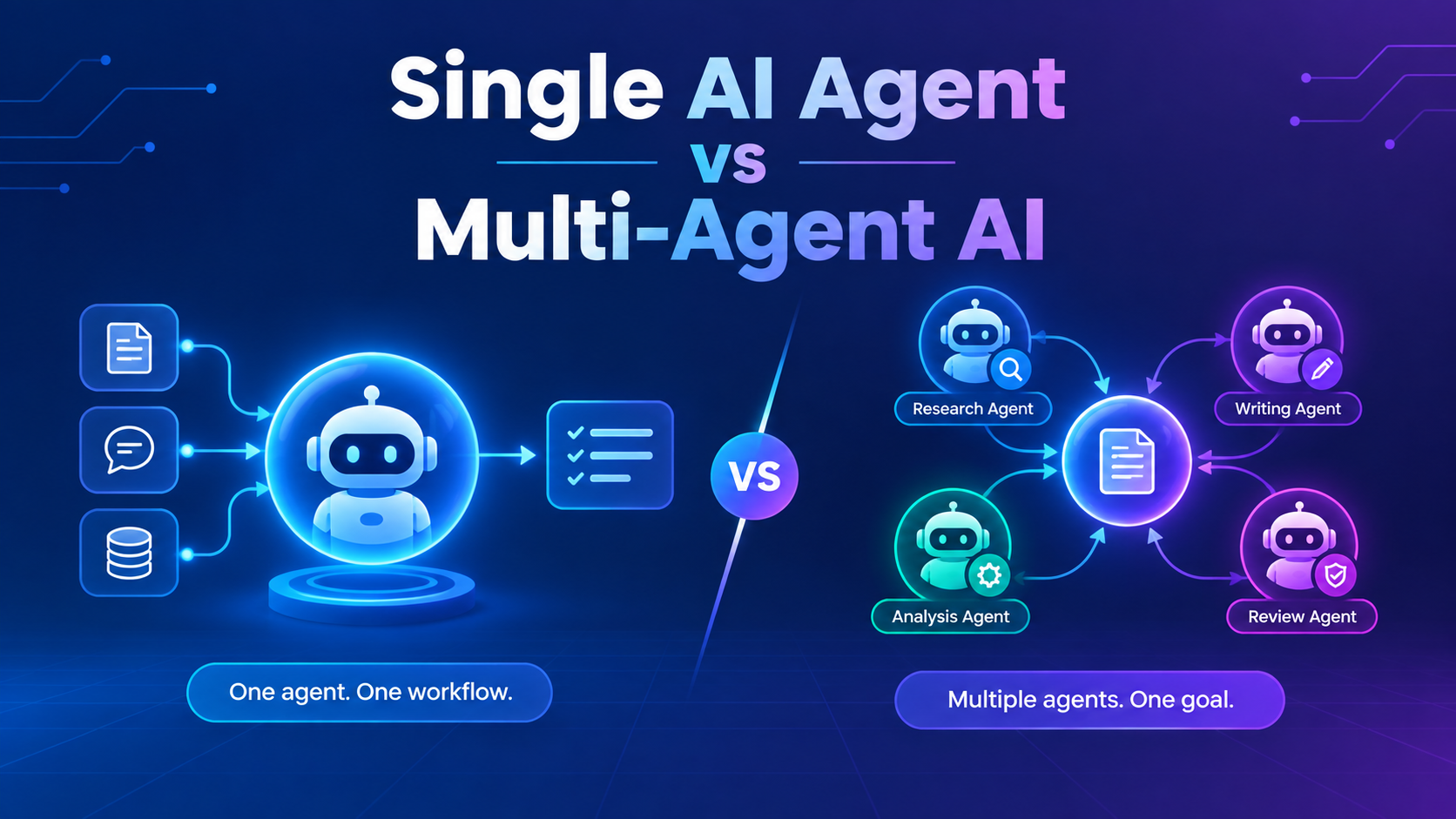
Single AI Agent vs Multi-Agent AI: Key Differences, Benefits and Use Cases
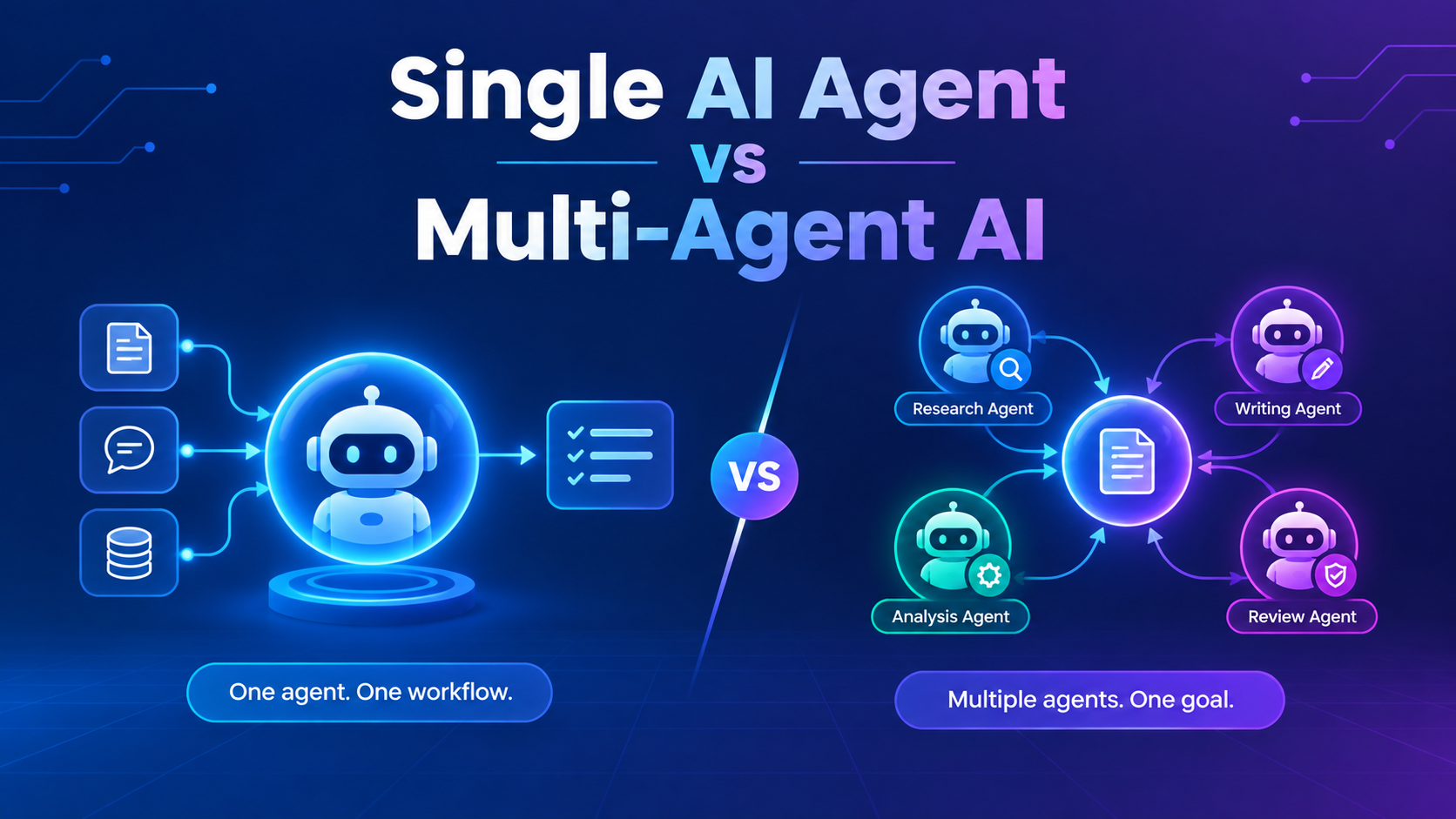
Learn the key differences between single AI agents and multi-agent AI, including how they work, their benefits, challenges, and real-world use cases.
Artificial intelligence is changing how people and businesses automate tasks. Single AI agents and multi-agent AI systems are two approaches for solving problems with AI. While a single agent can handle a task independently, a multi-agent system uses multiple specialized agents that can cooperate on different parts of a larger task.
Understanding single AI agent vs multi-agent AI can help you understand which approach may fit a particular workflow.
What Is a Single AI Agent?
A single AI agent is an AI system designed to perform a task or workflow using one main agent. It can receive an instruction, process information, make decisions, and take actions according to its assigned goal.
For example, a customer-support AI agent could:
Understand a customer's question
Search a knowledge base
Provide an answer
Perform a permitted action
Ask for human assistance when necessary
The important point is that one main agent manages the workflow.
What Is Multi-Agent AI?
Multi-agent AI involves multiple AI agents working together. Each agent can have a different role or responsibility.
For example, an AI content workflow could include:
Research Agent: gathers information
Keyword Agent: analyzes relevant search terms
Writing Agent: creates the draft
Review Agent: checks the content
SEO Agent: reviews optimization
Instead of one agent doing everything, the work can be divided between several agents.
Single AI Agent vs Multi-Agent AI
The main difference is how the work is organized.
. Feature
. Single AI Agent
. Multi-Agent AI
. Agents involved
. One
. Multiple
. Workflow
. Centralized
. Distributed/coordinated
. Task complexity
. Usually focused
. Can handle complex workflows
. Roles
. One main role
. Multiple specialized roles
. Coordination
. Limited
. More coordination required
. System management
. Simpler
. More complicated
How Does a Single AI Agent Work?
A typical single-agent workflow can look like:
User → AI Agent → Reasoning/Processing → Action → Result
Suppose a user asks an AI agent to summarize a document. The agent receives the document, identifies important information, creates the summary, and returns the result.
This approach can be useful when one agent can reasonably manage the complete task.
How Does Multi-Agent AI Work?
A multi-agent workflow can divide a larger task into smaller responsibilities.
For example:
User → Research Agent → Writing Agent → Review Agent → Final Result
Each agent contributes to the overall workflow.
However, adding more agents does not automatically make a system better. Communication, task assignment, error handling, and monitoring all need to be designed properly.
Benefits of Single AI Agents
1. Simpler Architecture
A single-agent system generally has fewer components to coordinate.
2. Easier Management
It can be easier to monitor one main agent and understand its workflow.
3. Good for Focused Tasks
Tasks with a clear objective can often be handled by one agent.
4. Easier Implementation
A simpler architecture can make development and testing more straightforward.
Benefits of Multi-Agent AI
1. Task Specialization
Different agents can focus on different responsibilities.
2. Complex Workflows
Large tasks can be divided into smaller steps.
3. Collaboration
Agents can exchange information or coordinate their work when the system is designed for collaboration.
4. Different Skills
One agent may specialize in research while another focuses on writing, analysis, coding, or reviewing.
Examples of Single AI Agents
Single AI agents can be used for various focused tasks, such as:
. Customer support
. Personal assistance
. Document summarization
. Data analysis
. Coding assistance
. Email-related automation
The exact capabilities depend on the AI model, tools, permissions, and system design.
Examples of Multi-Agent AI
Multi-agent systems can be useful for workflows involving several specialized tasks.
For example, an organization could create a workflow where:
Agent 1: Researches information
Agent 2: Analyzes the information
Agent 3: Creates a draft
Agent 4: Reviews the draft
The agents can then contribute to one final workflow.
Challenges of Multi-Agent AI
Multi-agent systems can also introduce additional complexity.
1. Coordination
Agents need clear instructions about when and how they should interact.
2. Communication
Information passed between agents needs to be accurate and understandable.
3. Monitoring
More agents can mean more components to monitor and troubleshoot.
4. Cost and Resources
Depending on the implementation, running multiple agents and AI model calls can require additional computing resources or API usage.
Single AI Agent vs Multi-Agent AI: Which Approach Fits?
There is no universal solution. The appropriate approach depends on the task.
A single AI agent may fit a focused workflow where one agent can complete the required steps.
A multi-agent system may fit a workflow where several specialized tasks can be separated and coordinated.
For example:
Task: “Summarize this document.”
→ A single agent may be sufficient.
Task: “Research a topic, analyze sources, prepare an article, review it, and check SEO.”
→ A multi-agent architecture could divide these responsibilities.
What is a single AI agent?
A single AI agent is an AI system where one main agent manages a task or workflow.
What is multi-agent AI?
Multi-agent AI is an approach where multiple AI agents work together or coordinate to complete a larger task.
What is the difference between a single agent and a multi-agent system?
A single-agent system uses one main agent, while a multi-agent system uses multiple agents that may have different responsibilities.
Are multi-agent systems always better?
Not necessarily. The appropriate architecture depends on the task, complexity, resources, and system requirements.
Conclusion
Single AI agents and multi-agent AI systems offer different ways to organize AI-powered workflows. A single agent can be useful for focused tasks, while multiple specialized agents can be used when a workflow can be divided into several coordinated responsibilities.
The key is to choose the architecture based on the actual task and user needs, rather than simply adding more AI agents.