Different Types of Agents in AI
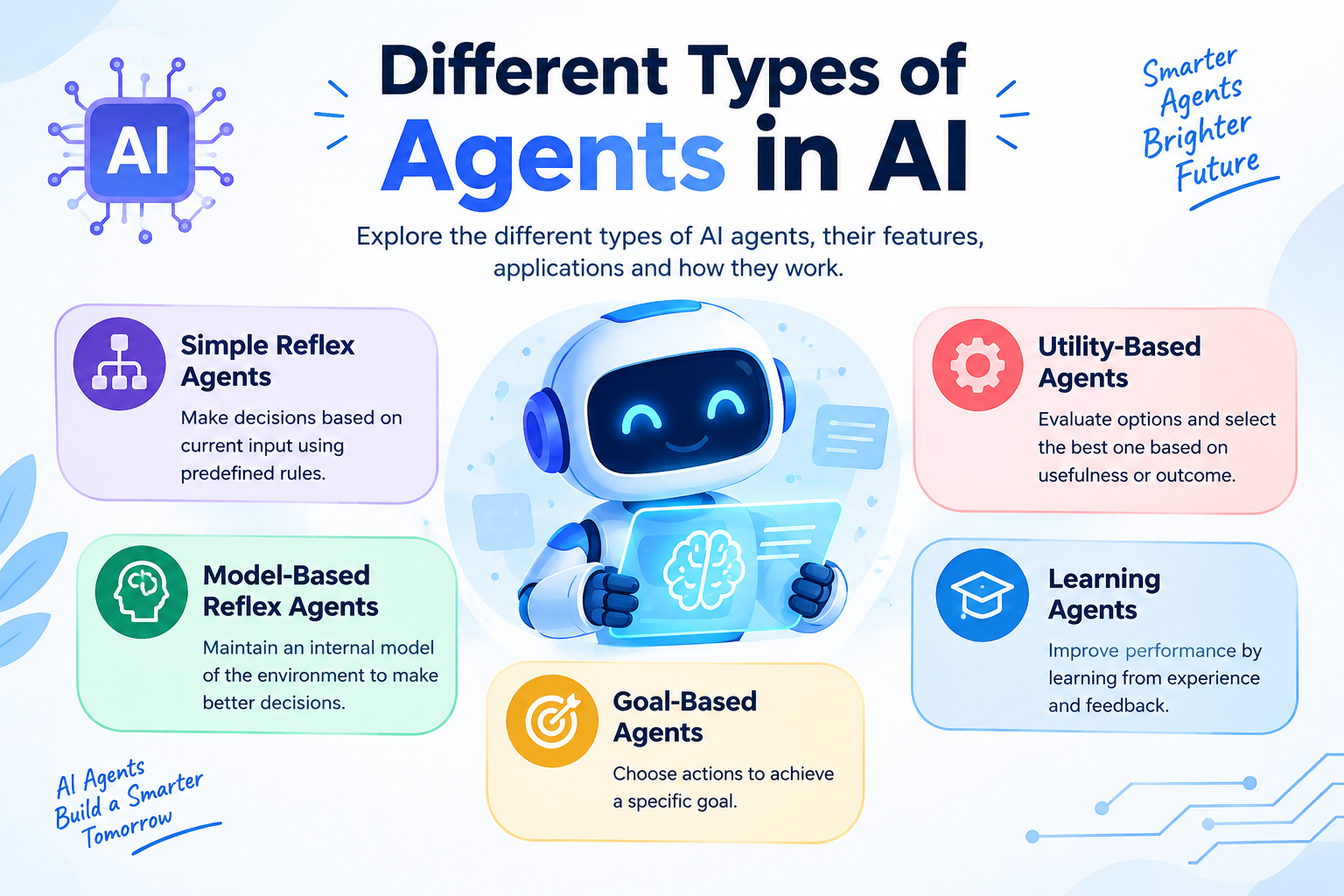
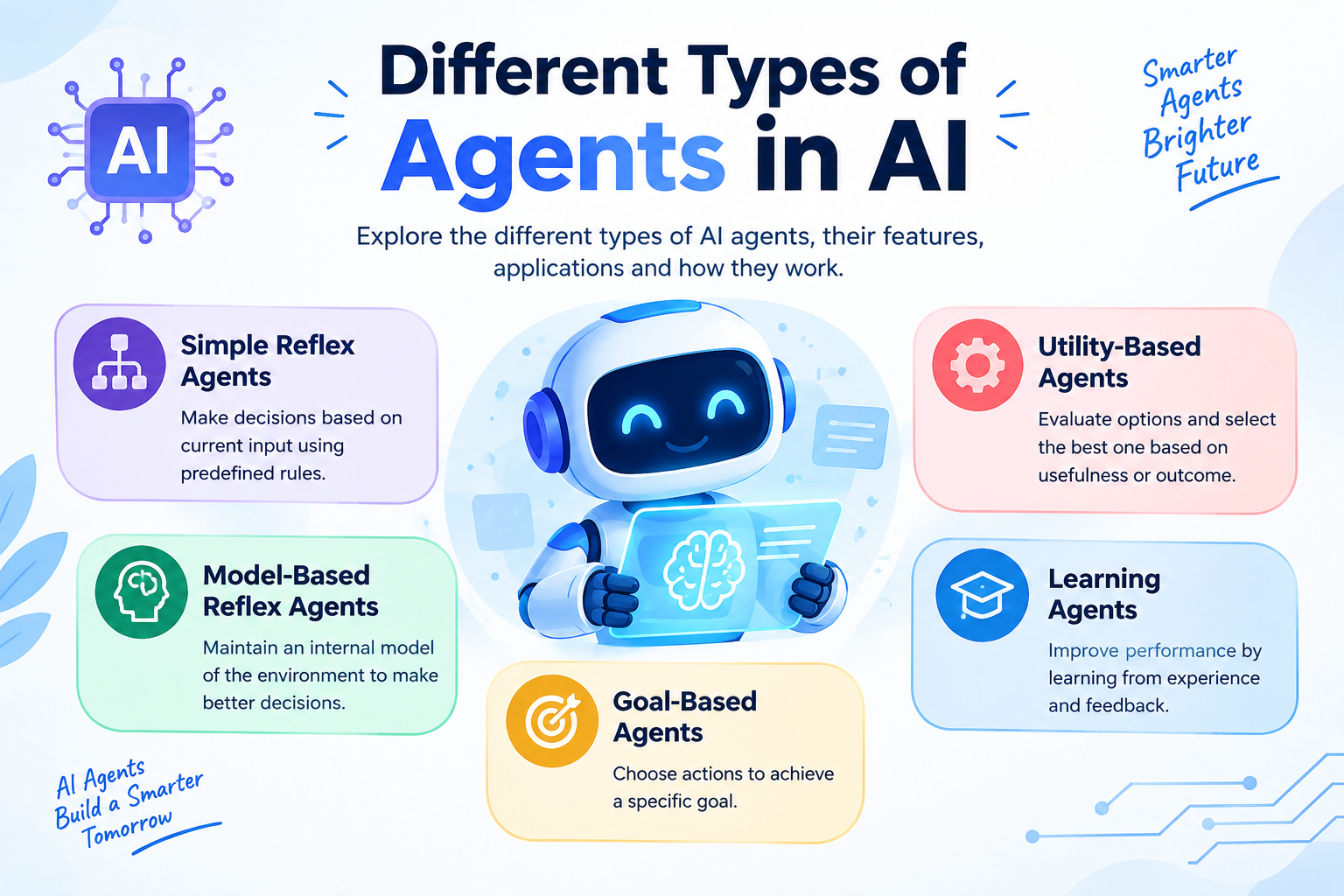
Explore the different types of agents in AI, their features, applications, benefits, limitations, and role in modern artificial intelligence.
Introduction
Artificial Intelligence (AI) agents are intelligent systems that can understand their environment, make decisions, and perform tasks to achieve specific goals. Different types of agents in AI are designed for different levels of complexity, from simple rule-based systems to advanced learning agents.
What Are AI Agents?
An AI agent is a software system that receives information from its environment through inputs, processes that information, and takes actions to achieve a goal. AI agents are widely used in chatbots, recommendation systems, autonomous vehicles, virtual assistants, and business automation.
Different Types of Agents in AI
There are several major types of AI agents. Each type has different capabilities and is suitable for different tasks.
1. Simple Reflex Agents
Simple reflex agents make decisions based on the current situation. They follow predefined rules such as “if this happens, do that.”
For example, a basic automatic light can turn on when it detects movement.
Key features:
Uses predefined rules
Responds to current input
Easy to design
Does not store past experiences
2. Model-Based Reflex Agents
Model-based reflex agents maintain an internal model of their environment. This allows them to make decisions even when they cannot observe everything directly.
For example, a robot can use information about its surroundings to navigate from one location to another.
3. Goal-Based Agents
Goal-based agents choose actions according to a specific goal. Instead of simply reacting to an input, they consider which action can help them reach their desired result.
For example, a navigation application can determine a route based on the destination selected by the user.
4. Utility-Based Agents
Utility-based agents evaluate different possible actions and select an option based on its usefulness or expected outcome.
For example, an AI system may compare different routes and select one that provides a better balance between travel time and distance.
5. Learning Agents
Learning agents improve their performance by learning from experience and feedback. They can adapt their behavior when they receive new information.
A recommendation system is an example of a learning agent because it can improve recommendations based on user interactions.
Why Are Different Types of Agents in AI Important?
Different AI agents are useful because every problem has different requirements. A simple task may only need a rule-based agent, while a complex environment may require an agent that can learn, plan, and adapt.
Choosing the appropriate type of agent can help organizations automate tasks, improve decision-making, and create more intelligent applications.
Applications of AI Agents
AI agents are used across many industries and everyday technologies, including:
Customer service: Chatbots can answer questions and assist customers.
Healthcare: AI systems can help analyze information and support clinical workflows.
Finance: Agents can assist with data analysis and fraud monitoring.
Education: AI tutors can provide personalized learning support.
E-commerce: Recommendation agents can suggest relevant products.
Transportation: Intelligent systems can support navigation and automation.
Smart homes: AI agents can control connected devices based on conditions and user preferences.
Advantages of AI Agents
AI agents can provide several benefits:
Automate repetitive tasks
Process large amounts of information
Respond quickly to changing situations
Support decision-making
Personalize user experiences
Work continuously without fatigue
Limitations of AI Agents
Despite their benefits, AI agents also have limitations. Their performance depends on the quality of their data, design, and environment. Complex agents can also require significant computing resources and careful testing.
AI systems may sometimes produce incorrect results, so human oversight can remain important, especially in sensitive applications.
Future of AI Agents
AI agents are becoming more capable of planning, learning, using tools, and completing multi-step tasks. Future AI systems may combine different agent capabilities to handle increasingly complex workflows.
As AI technology develops, organizations are likely to explore agents for automation, research, customer support, software development, and other practical applications.
Conclusion
Understanding the different types of agents in AI helps explain how intelligent systems make decisions and interact with their environments. Simple reflex, model-based, goal-based, utility-based, and learning agents each have different capabilities and applications.
Selecting the right type of AI agent depends on the task, environment, available information, and desired outcome. As artificial intelligence continues to develop, AI agents will remain an important part of intelligent software and automation.