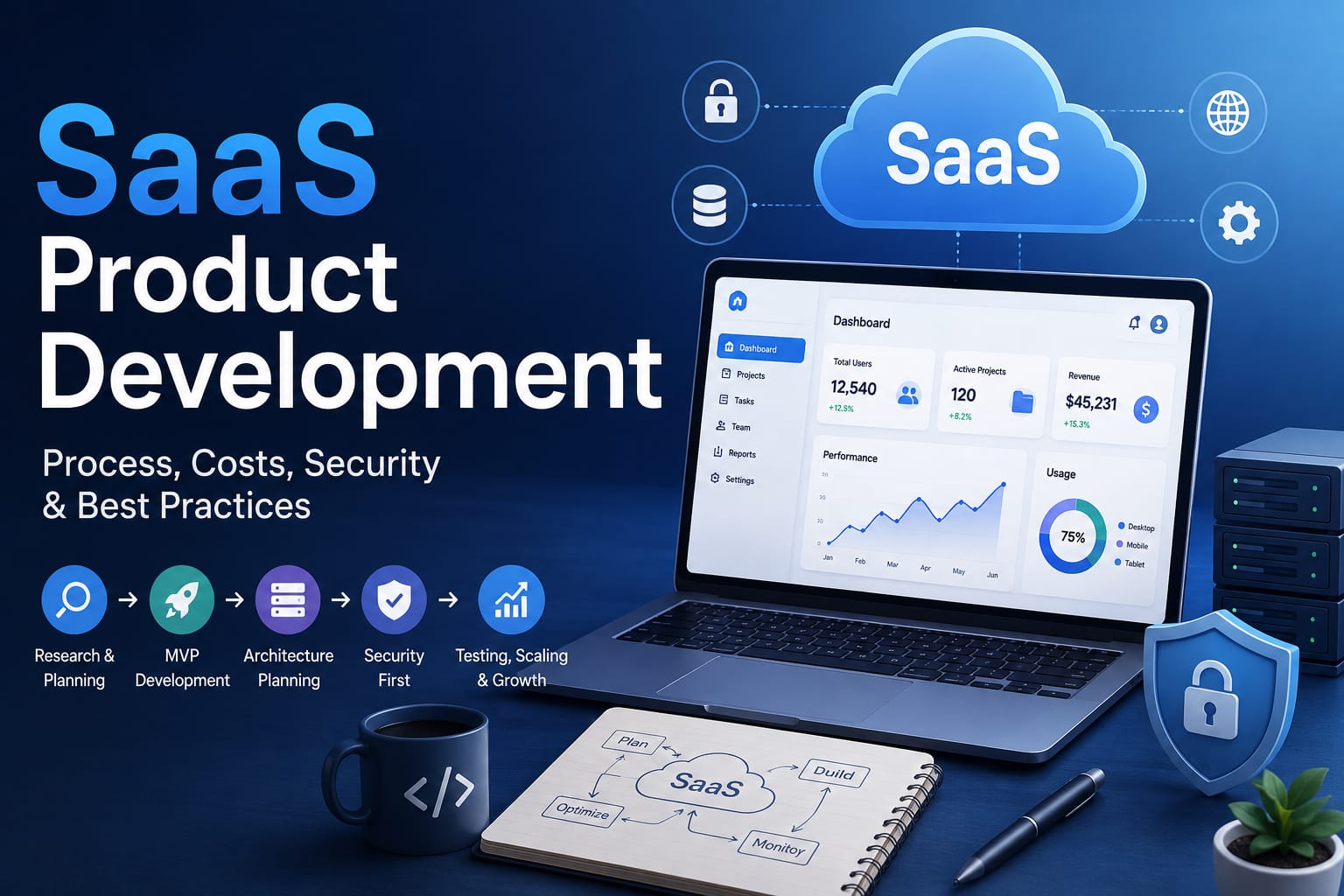
SaaS Product Development: Process, Costs, Security & Best Practices

Discover how SaaS product development works—from product planning and MVP development to scalable architecture, security, testing, and ongoing improvements. Learn the key practices for building a reliable SaaS product that delivers lasting value to users and supports business growth.
SaaS Product Development: Process, Costs, Security & Best Practices
Building a SaaS product is about more than putting software on the cloud. A successful product needs to solve a real customer problem, provide a smooth experience, protect user data, and remain reliable as usage grows. SaaS product development brings product strategy, UX design, software engineering, cloud infrastructure, security, and ongoing improvement into one continuous process.
Unlike traditional software that may be installed on individual devices, Software as a Service (SaaS) is delivered and operated by a provider. Customers access the application online, while the provider manages the underlying service, updates, and maintenance. This model creates convenience for users, but it also gives the provider an ongoing responsibility for the product's performance and reliability.
What Is SaaS Product Development?
SaaS product development is the process of planning, designing, building, testing, launching, and improving a software product delivered as an online service.
SaaS products can support many different needs, from project management and accounting to customer relationship management, communication, analytics, and business automation. The technical approach varies according to the product, but the underlying goal remains the same: create a useful service that can operate securely and reliably for its customers.
A key difference is that development does not simply end at launch. Because customers depend on the service continuously, teams need processes for monitoring, maintenance, updates, security, and future improvements.
Key Stages of SaaS Product Development
Developing a SaaS product involves several stages, and each stage contributes to the product's overall success. From defining the initial idea to improving the service after launch, teams need to make decisions about product requirements, technology, security, testing, and user experience. Following a structured development process helps teams manage these decisions and build a product that can adapt as customer needs and usage grow.
1. Research And Produc Planning
Before development begins, identify the problem the product is supposed to solve. Research the target audience, existing competitors, customer expectations, and potential gaps in current solutions.
This stage should produce a clear product scope. Define the core features, target users, business model, technical requirements, and measures of success before development becomes too far advanced.
A useful question is simple: Why would someone choose this product instead of an existing alternative?
The answer can help prevent teams from spending time and money on features that do not contribute to the product's main purpose.
2. Build an MVP
A minimum viable product (MVP) contains the smallest practical set of features needed to test the product's core value.
For example, an early project-management SaaS product might focus on user accounts, project creation, task management, and basic collaboration. More advanced reporting, integrations, or customization can be added after the team understands what users actually need.
This approach makes it easier to collect feedback and improve the product based on real usage rather than assumptions.
3. Plan the Architecture
Architecture decisions have a direct effect on scalability, security, performance, and operating costs.
Developers need to consider databases, APIs, authentication, storage, networking, cloud resources, monitoring, and deployment. They also need to decide how customers and their data will be isolated.
Many SaaS products use multitenant architecture, in which multiple customers share parts of the underlying infrastructure. The tenancy model should balance efficiency with requirements for data isolation, security, performance, and customer-specific needs.
Choosing technology simply because it is popular can create unnecessary problems later. The better approach is to select tools and architecture based on the product's actual requirements and expected growth.
Security Should Be Part of Development
Security should not be treated as a final step before launch. SaaS providers are responsible for protecting the service and the customer information stored or processed within it.
Depending on the product, security measures may include strong authentication, authorization, least-privilege access, encryption, secure APIs, vulnerability management, logging, and monitoring. Microsoft recommends establishing security practices early and continuously reviewing the security posture as the product evolves.
A secure development process also considers third-party dependencies and development tools. Security testing and automated scanning can help identify vulnerabilities before they reach production.
Testing, Performance, and Reliability
A SaaS product needs to perform consistently under real-world conditions. Functional testing confirms that features work as expected, while performance and load testing can reveal how the application behaves as usage increases.
Reliability also requires operational planning. Monitoring, logging, backups, incident response, and recovery procedures help teams detect problems and respond to them effectively.
Scalability should be considered before the product experiences rapid growth. Teams can identify likely scale points, such as the number of customers, users, transactions, or stored data, and design the system around realistic growth scenarios.
User Experience Still Matters
Strong technology cannot compensate for a confusing product.
Users should be able to understand the interface, complete important tasks efficiently, and recover easily when something goes wrong. Clear navigation, straightforward onboarding, responsive design, and useful error messages can make the service easier to use.
After launch, customer feedback becomes an important source of product insight. Support requests, reviews, usage patterns, and direct feedback can reveal which features need improvement and where users are experiencing friction.
How to Build a SaaS Product That Can Grow
Growth brings new technical and operational challenges. More customers can increase infrastructure costs, data volume, support requirements, and the complexity of deployments.
For this reason, SaaS teams should think about automation and operational processes early. Microsoft recommends consistent deployment practices, progressive rollouts, monitoring, and planning for future architectural changes as the customer base grows.
The goal is not to build the most complicated architecture from day one. It is to build a solid foundation that can evolve without forcing the entire product to be redesigned.
Conclusion
SaaS product development is an ongoing process that combines product thinking with strong engineering and operational practices. A good SaaS product starts with a genuine customer problem, validates its idea through an MVP, and then grows through thoughtful architecture, security, testing, and user feedback.
The best development approach is not simply about adding more features. It is about creating a service that customers can trust, use comfortably, and continue to rely on as their needs—and the product itself—grow.