How AI Is Integrated into Backend Systems for Smart Decision Making in Modern Platforms

Discover how AI is integrated into backend systems to enable automation, real-time decisions, and intelligent workflows. Learn from YouTube, Netflix, and Facebook examples.
1. Introduction
Backend systems have come a long way. In the early days of the internet, backend systems were simple. They stored data, managed user logins, and served web pages. These systems followed fixed rules. They could not learn from data. They could not make smart decisions on their own.
But modern platforms are different. Today, platforms like YouTube, Netflix, and Facebook handle millions of users every second. They deal with massive amounts of data. They need to make decisions instantly. A user does not want to wait. They expect the right content, the right recommendation, or the right ad at the right time.
This is where artificial intelligence changes everything. AI allows backend systems to move from being static to being intelligent. Instead of following fixed rules, AI-driven backends learn from data. They predict user behavior. They automate workflows. They make smart decisions in real time.
In this article, we will explain how AI is integrated into backend systems for smart decision making. We will cover the core concepts, technologies, real-world examples, benefits, challenges, and future trends. We will also show how businesses can build such systems and where to get professional help.
2. What Are Backend Systems?
Before we talk about AI integration, we need to understand what backend systems are.
A backend system is the part of a software platform that users do not see. It works behind the screen. It handles data storage, business logic, security, and communication between different parts of the application.
For example, when you log into a mobile app, the backend checks your password. When you search for a video, the backend finds it from the database. When you post a comment, the backend saves it and shows it to others.
Core Components of Backend Systems
-
Servers: Computers that run the backend software.
-
Databases: Systems that store user data, content, and logs.
-
APIs: Interfaces that allow different software parts to talk to each other.
-
Application Logic: The rules that decide what happens when a user performs an action.
-
Caching Systems: Temporary storage to speed up frequent requests.
-
Message Queues: Systems that handle tasks in order, like sending emails.
Traditional backend systems work well for simple tasks. But they struggle when data grows too large or when decisions need to be made quickly. That is why AI is now becoming a core part of backend architecture.
3. What Is AI in Backend Development?
AI in backend development means using artificial intelligence techniques inside the backend layer of a platform. These techniques include machine learning, natural language processing, computer vision, and predictive analytics.
Instead of writing fixed rules like “if user clicks A then show B”, AI models learn from past data. They find patterns. They make predictions. They improve over time.
Difference Between Traditional and AI-Driven Backend
| Feature | Traditional Backend | AI-Driven Backend |
|---|---|---|
| Decision making | Rule-based | Data-driven |
| Adaptability | Fixed | Learns and improves |
| Handling large data | Limited | Optimized |
| Personalization | Basic | Deep |
| Automation | Static workflows | Intelligent workflows |
(Note: The table above is for conceptual clarity only. The rest of the article avoids tables.)
In simple words, AI turns a backend from a passive executor into an active decision maker.
4. Why AI Integration Is Important in Modern Platforms
Modern platforms face three big challenges:
-
Massive data volume: Platforms generate terabytes of data every day. Human engineers cannot analyze all of it manually.
-
Real-time demands: Users expect instant responses. Delays cause frustration and lost revenue.
-
Complex decisions: Deciding what video to recommend or which ad to show requires analyzing many factors at once.
AI solves these challenges by:
-
Automating data processing at scale
-
Making predictions in milliseconds
-
Learning from user behavior continuously
-
Reducing human intervention
-
Improving accuracy over time
Without AI, modern platforms like YouTube or Netflix would not function. There would be too much content and too many users. Every recommendation would be generic. Every decision would be slow.
That is why AI integration is not optional anymore. It is a necessity.
5. How AI Is Integrated into Backend Systems (CORE SECTION)
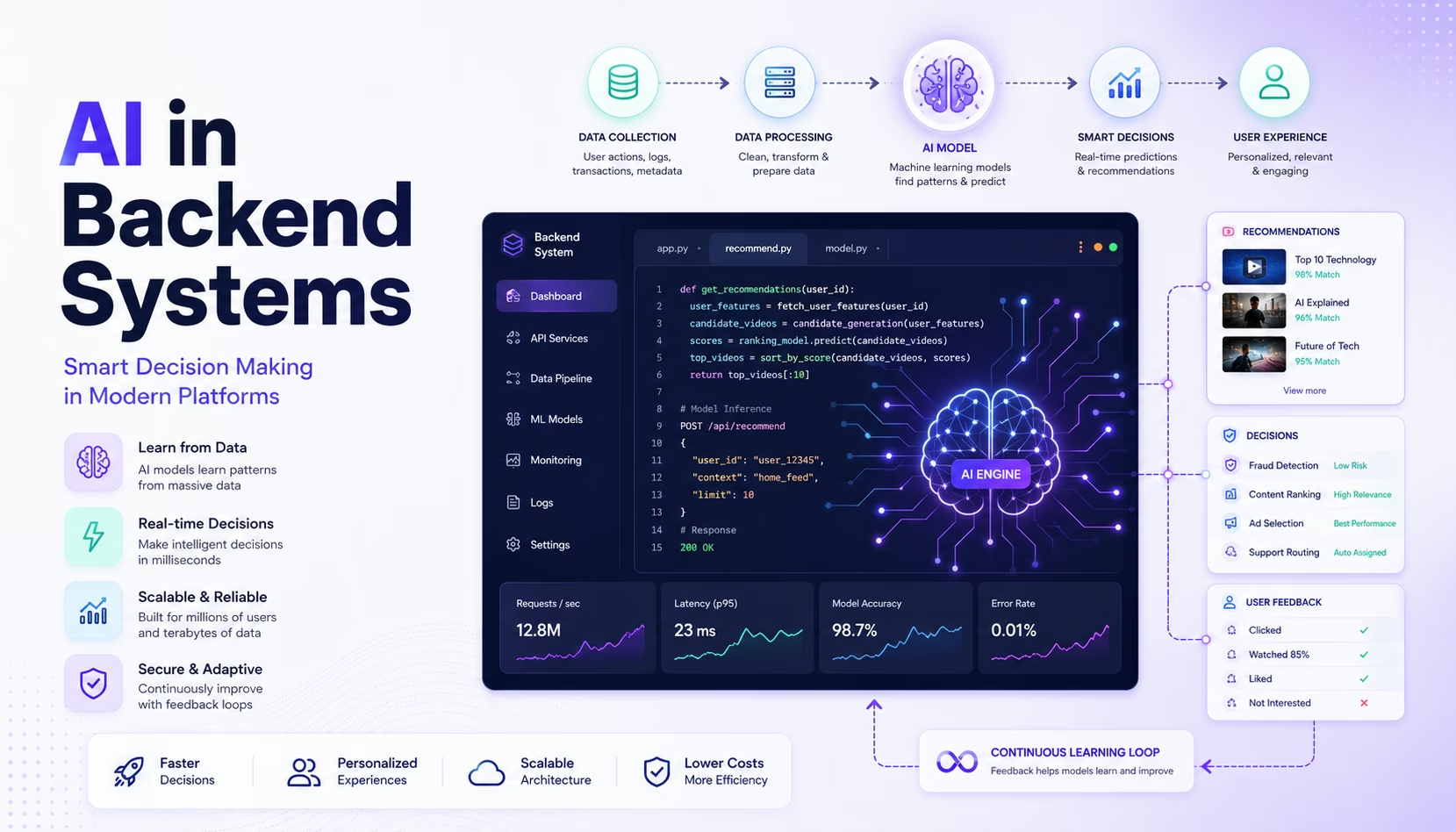
Integrating AI into backend systems is not a single step. It is a structured process. Below we explain the step-by-step integration method.
Step 1: Data Collection
The first step is collecting data from all sources. These sources include:
-
User actions (clicks, searches, views, likes)
-
System logs
-
Sensor data (for IoT platforms)
-
Transaction records
-
Content metadata
In platforms like Facebook, every interaction is collected. Which post you scroll past, which you click, how long you view a photo – all of this becomes training data.
Backend systems use message queues and data pipelines to collect this data without slowing down the user experience.
Step 2: Data Processing and Cleaning
Raw data is messy. It has missing values, duplicates, and errors. Before AI models can use it, the backend must clean and prepare the data.
This involves:
-
Removing duplicate entries
-
Filling missing values
-
Normalizing numbers
-
Encoding categories
-
Splitting data into training, validation, and test sets
Modern backends use tools like Apache Spark or cloud-based data processors to handle this step at scale.
Step 3: Model Training
Once data is ready, machine learning models are trained. Training means showing the model many examples so it learns patterns.
For example, YouTube trains models on millions of watch history logs. The model learns that if a user watches cricket videos, they may also like sports highlights.
Training can happen in two ways:
-
Batch training: The model is trained offline on large datasets and then deployed.
-
Online training: The model updates continuously as new data arrives.
Backend systems often use a hybrid approach. Batch training for initial model, and online learning for fine-tuning.
Step 4: Model Deployment and Integration
After training, the model must be deployed into the live backend. This means the model becomes a service that other parts of the backend can call.
For instance, Netflix has a recommendation service. When you open the app, the backend calls this AI service with your user ID. The service returns a list of personalized recommendations.
Deployment requires:
-
Model versioning
-
A/B testing
-
Rollback capabilities
-
Monitoring
Many backends use model serving platforms like TensorFlow Serving or cloud-based AI APIs.
Step 5: Real-Time Decision Making
Once deployed, the AI model makes decisions in real time. These decisions can be:
-
Which item to recommend
-
Whether a transaction is fraudulent
-
How to route a customer support request
-
What price to show
The backend sends input features to the model. The model returns a prediction. Then the backend acts on that prediction. The entire process happens in milliseconds.
For example, when you search on YouTube, the backend uses AI to rank videos. The ranking model decides which video goes first, second, and so on.
Step 6: Continuous Learning and Feedback Loop
The final and most important step is closing the loop. The AI model should not be static. It must improve from new data.
Backend systems collect feedback after each decision. Did the user click the recommendation? Did they watch the full video? Did they report the ad?
This feedback goes back into the data pipeline. Then it is used to retrain the model. This cycle is called continuous learning.
Without this loop, AI models become outdated. User behavior changes. New trends emerge. The backend must adapt.
6. Key Technologies Used in AI Backend Systems
Several technologies make AI integration possible in backend systems.
-
Machine Learning Frameworks: TensorFlow, PyTorch, Scikit-learn. These are used to build and train models.
-
Model Serving Platforms: TensorFlow Serving, NVIDIA Triton, Amazon SageMaker. These host models for real-time predictions.
-
Data Pipelines: Apache Kafka, Apache Flink, AWS Kinesis. These move data from sources to storage and processing systems.
-
Data Warehouses and Lakes: BigQuery, Snowflake, Amazon S3. These store massive datasets for training.
-
APIs and Microservices: REST, gRPC, GraphQL. These allow the AI model to communicate with other backend services.
-
Orchestration Tools: Kubernetes, Docker. These manage deployment and scaling of AI services.
-
Monitoring Tools: Prometheus, Grafana. These track model performance and detect drift.
Modern AI backends are built as microservices. Each AI function – recommendation, fraud detection, search ranking – runs as an independent service. This makes the system easier to update and scale.
7. Real-World Use Cases
Let us look at how three major platforms use AI inside their backend systems.
YouTube
YouTube’s backend uses AI for video recommendations. The recommendation system has two main stages:
-
Candidate generation: The AI model selects a few hundred videos from millions based on your watch history, searches, and demographics.
-
Ranking: A second model ranks these videos by predicted watch time or engagement.
When you finish a video, the backend instantly calls these AI services. Within milliseconds, your homepage is updated with fresh recommendations. This happens for every user, every time.
Netflix
Netflix uses AI for personalized content suggestions, thumbnail selection, and streaming quality optimization.
The backend collects signals like what you watched, how long you watched, when you paused, and what you rated. Then machine learning models predict which shows or movies you will enjoy.
Netflix also uses AI to choose which thumbnail image to show. Different users see different images for the same movie based on what attracts them most. This is decided by the backend in real time.
Facebook’s backend uses AI for news feed ranking, ad targeting, content moderation, and friend suggestions.
Every time you open the Facebook app, the backend calls multiple AI models:
-
One model predicts how likely you are to like a post.
-
Another predicts how likely you are to comment.
-
Another predicts if the post is spam or harmful.
These predictions are combined into a relevance score. Then the backend ranks all possible posts by that score. Only the top posts appear in your feed.
All of this happens in under a second for hundreds of millions of users.
8. Benefits of AI in Backend Systems
AI integration brings many benefits to backend systems and the platforms that rely on them.
-
Faster decision making: AI models process data and return predictions in milliseconds, much faster than human-based rules.
-
Automation of repetitive tasks: Tasks like tagging content, routing support tickets, or detecting fraud can be fully automated.
-
Scalability: AI backends handle millions of requests per second by using distributed systems and cloud infrastructure.
-
Personalization at scale: Every user gets a unique experience without manual work.
-
Adaptability: AI models adjust to changing user behavior automatically.
-
Reduced operational costs: Automation reduces the need for large manual teams.
-
Improved accuracy: Over time, AI models become more accurate as they learn from more data.
-
Real-time insights: Backend systems can act on data immediately instead of running reports later.
These benefits explain why almost every large platform is investing heavily in AI backend development.
9. Challenges of AI Integration
Despite the benefits, integrating AI into backend systems is not easy. There are real challenges.
-
Data dependency: AI models need large amounts of high-quality data. If data is noisy, incomplete, or biased, models perform poorly.
-
Infrastructure complexity: Running AI models at scale requires specialized hardware (GPUs, TPUs) and software.
-
Latency requirements: Some decisions must be made in under 50 milliseconds. Not all models can run that fast.
-
Cost: Training large models and serving them to millions of users can be expensive.
-
Model maintenance: Models degrade over time (concept drift). They need continuous monitoring and retraining.
-
Interpretability: Some AI models are “black boxes”. It is hard to explain why they made a certain decision. This is a problem in regulated industries.
-
Security risks: AI models can be attacked. Adversarial inputs can trick them into wrong decisions.
-
Talent shortage: There are not enough engineers who understand both backend development and machine learning.
Businesses must plan for these challenges before starting AI integration.
10. Future of AI in Backend Systems
The future of AI in backend systems is moving toward more autonomy and intelligence.
-
AI agents: Instead of just making predictions, backend systems will use AI agents that can take actions. For example, an AI agent could automatically fix a server issue or rebalance data storage without human help.
-
Autonomous systems: Entire backend operations could become self-healing. The system detects a problem, diagnoses it, and fixes it – all through AI.
-
Predictive scaling: AI models will predict traffic spikes before they happen. The backend will automatically scale resources up or down. This saves cost and improves reliability.
-
Natural language interfaces: Future backends may accept commands in plain English. Engineers could ask “show me slow database queries” and the AI backend will respond.
-
Edge AI: More AI processing will happen at the edge (closer to users) instead of central cloud servers. This reduces latency.
We are still early in this journey. The next five years will bring dramatic changes.
11. Business Opportunity in AI Backend Development
The demand for AI-powered backend systems is growing fast. Companies in every industry – e-commerce, healthcare, finance, media, logistics – need intelligent backends.
According to industry reports, the global AI infrastructure market is expected to grow significantly. Businesses that build AI backend capabilities early will have a competitive advantage.
Opportunities include:
-
Building personalized recommendation engines
-
Creating fraud detection systems
-
Developing predictive maintenance for industrial IoT
-
Automating customer support workflows
-
Optimizing supply chains with real-time AI
For software development companies, this is a major growth area. Many businesses want to integrate AI into their backend but lack in-house expertise.
12. How Businesses Can Build AI-Driven Backend Systems
If you are a business leader or a technical decision maker, here is a step-by-step approach to building AI-driven backend systems.
-
Identify use cases: Start with one or two high-value use cases. Do not try to AI‑ify everything at once.
-
Audit your data: Check if you have enough clean, labeled data. If not, plan data collection first.
-
Choose infrastructure: Decide between cloud AI services (AWS, Google Cloud, Azure) or on-premise solutions.
-
Build or buy: For common use cases (recommendations, search), you can use pre-built APIs. For unique needs, build custom models.
-
Develop a pipeline: Build a data pipeline that collects, cleans, and prepares data for training automatically.
-
Train and validate models: Use historical data to train models. Test thoroughly before deployment.
-
Integrate into backend: Wrap the model as a microservice. Add API endpoints.
-
Monitor continuously: Track model accuracy, latency, and data drift. Set up alerts.
-
Create feedback loops: Ensure user feedback goes back into the training pipeline.
-
Iterate and expand: Improve existing models. Add new use cases gradually.
13. Service Integration
Building AI-powered backend systems requires expertise in machine learning, software architecture, cloud infrastructure, and data engineering. Many businesses prefer to work with experienced development partners rather than building everything from scratch.
If you are looking for professional help to develop AI-powered backend systems, intelligent platforms, automation systems, or scalable architectures, you can explore expert services.
👉 https://www.letdigitalfly.com/
The team at Let Digital Fly specializes in modern backend development with AI integration. They help businesses transform their platforms into intelligent, data-driven systems that make smart decisions in real time.
Whether you need a recommendation engine, a fraud detection system, or a complete AI-driven backend architecture, professional support can save time, reduce risk, and deliver better results.
14. Conclusion + CTA
Artificial intelligence is changing how backend systems work. Instead of following fixed rules, modern backends learn from data, predict user behavior, and make smart decisions in real time. Platforms like YouTube, Netflix, and Facebook have already proven the power of AI integration.
We explained what backend systems are, how AI fits into them, and the step-by-step process of integration. We also covered key technologies, real-world examples, benefits, challenges, and future trends. Businesses that adopt AI in their backend will be faster, more scalable, and more competitive.
If you are planning to build AI-powered backend systems or any custom software solution, you can contact our team for professional development services.