Facebook, Facebook Marketplace, and StreamEast: How Modern Digital Platforms Drive User Engagement and Online Revenue Models

Learn how Facebook, Facebook Marketplace, and StreamEast attract users, sustain engagement, and generate revenue — with a deep look at platform architecture, monetization models, and UI/UX design strategy.
Introduction: The Age of Platform-Driven Digital Economies
The internet no longer just connects people — it organizes entire economies around them. Over the past two decades, a relatively small number of digital platforms have become the primary channels through which billions of people communicate, shop, consume entertainment, and conduct business. These platforms are not passive tools. They are engineered systems designed to attract users, hold their attention, reward their participation, and generate commercial value at every layer of the experience.
Understanding how these systems work is no longer relevant only to engineers or product designers. Entrepreneurs, marketing professionals, investors, and business leaders all need a clear picture of how platforms like Facebook operate, why Facebook Marketplace has become a significant force in local commerce, and what the rise of streaming-focused platforms like StreamEast reveals about shifting user expectations around content access.
This article analyzes each of these platforms in depth — not just what they do, but how they are built, why users engage with them, and how they convert that engagement into sustainable revenue. For businesses considering building their own digital platforms, the structural lessons here are directly applicable.
Overview of Facebook as a Digital Platform
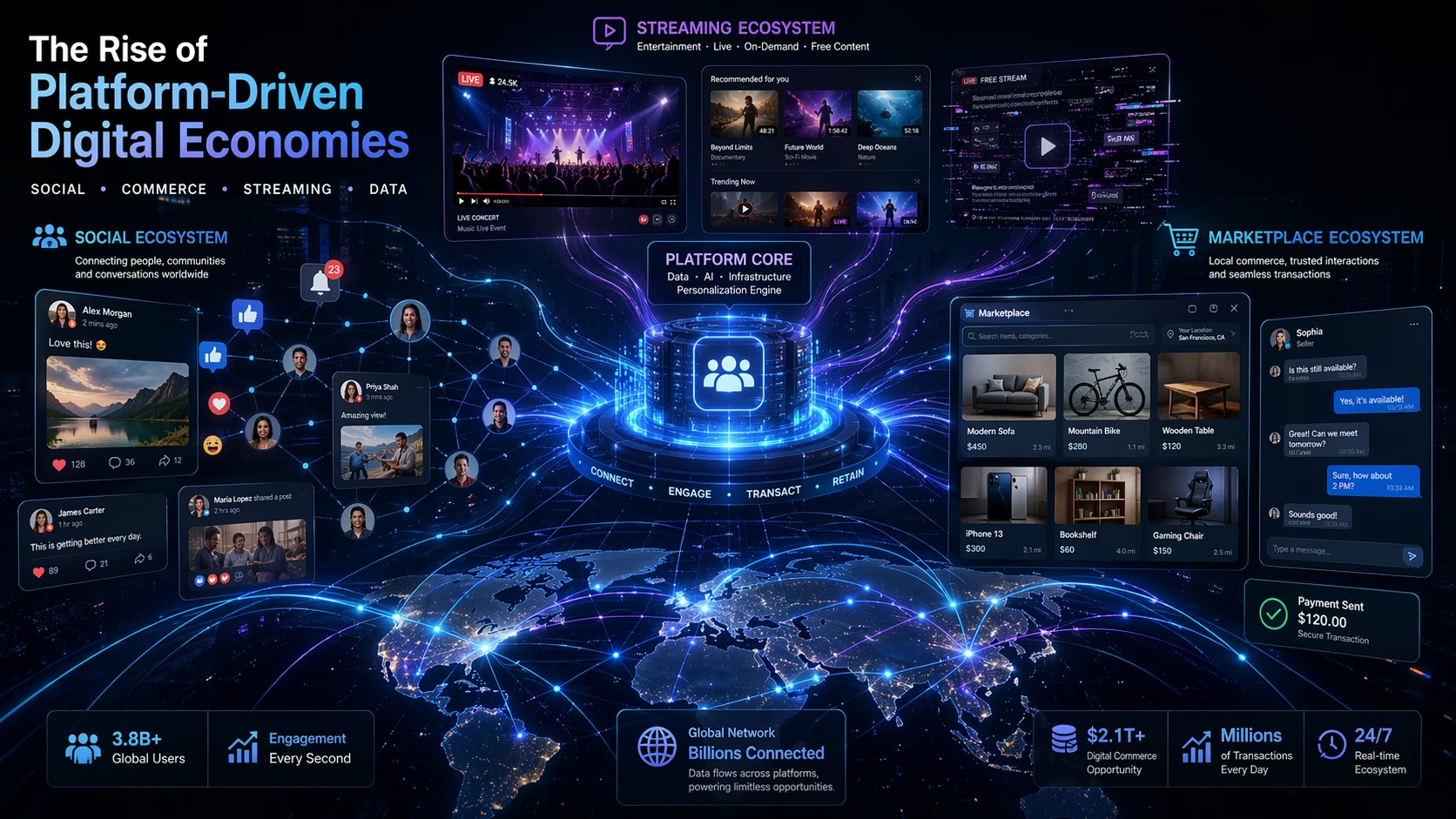
Facebook is the most-used social network in the world, with over three billion monthly active users across its family of apps. But calling it a social network undersells what it actually is. Facebook is a platform infrastructure — a set of interconnected systems that connect people, distribute content, enable commerce, and serve advertising, all within a single unified product experience.
The News Feed and Algorithmic Content Distribution
The News Feed is Facebook's central engagement surface. When a user opens the app, they do not see a chronological list of posts from friends. They see a curated feed assembled by an algorithm that evaluates hundreds of signals: who the user interacts with most, what type of content they engage with, how long they spend viewing specific posts, what they comment on versus scroll past, and when they are most active.
This system is designed with a clear objective — maximize time spent on the platform. The algorithm learns continuously. The more a user interacts, the more precisely the feed reflects their preferences, which drives further interaction. This feedback loop is the foundation of Facebook's engagement model.
Community and Group Architecture
Beyond individual connections, Facebook has invested heavily in Groups as an engagement layer. Facebook Groups function as interest-based communities where users with shared topics — local neighborhoods, hobby niches, professional fields, support networks — gather to exchange content and conversation. Groups create a sense of belonging that keeps users returning not just to see what their friends are doing, but to participate in ongoing community discussions.
From a platform design perspective, Groups solve a critical retention problem. Individual friendship networks naturally go quiet over time. Interest-based communities generate continuous, topic-driven content that does not depend on the activity of any one person.
Events, Stories, and Multi-Format Content
Facebook supports multiple content formats — text posts, images, video, live streams, Stories, and Reels — allowing the platform to compete across different consumption contexts. A user might read a text post, watch a short video, and respond to an event invitation all within the same session. This multi-format design increases the surface area of engagement and reduces the likelihood that a user will exhaust their reason to stay within a single session.
Facebook Marketplace and the Evolution of Social Commerce
Facebook Marketplace launched in 2016 and has grown into one of the most widely used peer-to-peer buying and selling platforms globally. Its growth was not driven by superior technology — it was driven by distribution. Facebook already had billions of users. Marketplace simply gave those users a new way to interact with each other.
How Facebook Marketplace Works
Marketplace is a listings-based commerce system embedded directly within the Facebook app. Sellers post items with photos, descriptions, and prices. Buyers browse listings filtered by location, category, and price range. Communication happens through Facebook Messenger, and transactions are typically completed in person or, increasingly, through Facebook's integrated payment and shipping systems.
The local commerce model is central to its appeal. Unlike Amazon or eBay, Marketplace's default browsing mode is geographically anchored. Users see listings near them first. This makes it particularly effective for large items — furniture, vehicles, appliances — that are impractical to ship, as well as for casual sellers who want to quickly move secondhand goods without creating a formal seller account on a dedicated platform.
Trust Through Social Identity
One of Marketplace's structural advantages over anonymous classifieds platforms is identity verification through Facebook profiles. When a buyer contacts a seller, they can view the seller's profile, mutual friends, and Marketplace ratings. This social layer of trust reduces the anxiety that often accompanies transactions between strangers online, which directly increases conversion rates.
This is not a technical feature — it is a design decision that leverages an existing social asset. Facebook's identity infrastructure, built for social networking, becomes a trust mechanism for commerce. Few competitors can replicate this without a pre-existing social graph of comparable scale.
Expanding Into Managed Commerce
Facebook has progressively added more structured commerce features to Marketplace: integrated checkout, Facebook Shops for small businesses, shipping labels, and buyer and seller protections on eligible transactions. These additions move Marketplace from a pure peer-to-peer classifieds model toward a managed commerce ecosystem, increasing both utility and revenue potential for Meta.
StreamEast and the Analytical Case for Free Streaming Platforms
StreamEast is a free streaming platform primarily associated with live sports broadcasting. It operates without the licensing agreements that govern legitimate streaming services, which raises clear legal concerns. This section examines the platform from a strictly analytical standpoint — to understand what market conditions produce demand for unauthorized streaming and what that demand signals about the broader industry.
Why Free Streaming Platforms Attract Large Audiences
The core driver is accessibility. Live sports rights in most major markets are fragmented across multiple paid streaming services and traditional broadcasters. A fan wanting comprehensive access to football, basketball, soccer, and combat sports might need four or five separate subscriptions, representing a significant monthly cost. In markets where income levels make these costs prohibitive, or in regions where licensed streaming services are not available, audiences seek alternatives.
StreamEast and similar platforms fill this gap by aggregating streams without licensing costs, keeping the service free and ad-supported. The user experience is generally poor — unreliable streams, aggressive advertising, and no customer support — but the price point of zero is a powerful draw for a segment of the audience that the formal market is not adequately serving.
What This Signals for the Industry
The sustained traffic to unauthorized platforms is not primarily a piracy problem — it is a market design problem. When legal alternatives are too expensive, too fragmented, or geographically restricted, audiences find workarounds. The streaming industry's long-term response — bundling services, expanding geographic licensing, introducing lower-cost ad-supported tiers — reflects an understanding that accessibility drives legitimate adoption.
From a business perspective, the existence of platforms like StreamEast represents an addressable market that paid services have not fully captured. Any business entering the streaming space should treat this audience as a potential customer base, not a lost cause.
Core User Engagement Strategies Across Digital Platforms
Facebook, Marketplace, and streaming platforms all use overlapping engagement strategies rooted in behavioral psychology and data-driven design. Understanding these strategies is essential for anyone building a digital product.
Personalization at Scale
Every major platform today delivers a personalized experience. What you see is not what another user sees. Content, listings, recommendations, and advertising are all filtered through individual behavioral profiles. Personalization increases relevance, and relevance increases engagement. The more useful a platform feels, the more time users spend on it and the more frequently they return.
Notification Systems as Re-Engagement Tools
Push notifications, email digests, and in-app alerts are engineered re-engagement tools. A Facebook notification about a comment on your post, a Marketplace inquiry from a potential buyer, or a reminder that a streamed event is about to begin all serve the same function: pulling a user back into the platform at a moment when they might otherwise be elsewhere. Notification systems are carefully tuned to maximize re-engagement without triggering fatigue that causes users to disable them entirely.
Social Proof and Interaction Loops
Likes, comments, shares, and replies create interaction loops that reward participation. When a user posts content and receives reactions, the social validation reinforces the behavior, making them more likely to post again. This loop is fundamental to Facebook's content supply model — the platform depends on users generating content, and social rewards are the mechanism that sustains content creation.
Behavioral Triggers in Commerce
On Marketplace, design elements like "X people have viewed this listing" and rapid response indicators on seller profiles create urgency and trust signals that accelerate purchase decisions. These micro-design decisions — often invisible to users — significantly affect conversion rates.
Reducing Friction at Every Step
Across all platform types, reducing friction is a primary engagement strategy. Fewer clicks to complete an action, faster load times, smoother onboarding, and intuitive navigation all reduce the effort required to use the platform. Lower effort means higher completion rates for key actions — posting, purchasing, subscribing, sharing.
Revenue Models of Modern Digital Platforms
Digital platforms rarely depend on a single revenue stream. The most resilient platforms layer multiple models that complement each other.
Advertising Revenue
Facebook's primary revenue source is targeted advertising. Meta's advertising system allows brands to reach specific audience segments defined by demographics, interests, behaviors, location, and even life events. The granularity of Facebook's user data — accumulated over nearly two decades — makes its ad inventory exceptionally valuable. Advertisers pay for impressions and clicks, and the auction-based system means prices reflect real-time demand.
Transaction-Based Revenue
Marketplace generates revenue through transaction fees on managed payments, promoted listings that give sellers greater visibility, and advertising placements within the commerce interface. As Facebook has expanded Marketplace's managed commerce features, the transaction layer has become a growing revenue contribution alongside its advertising base.
Subscription and Premium Models
Meta has introduced Meta Verified, a subscription tier offering account verification and additional support features. This mirrors a broader industry trend of layering subscription revenue on top of free, ad-supported platforms. Streaming platforms like StreamEast's legitimate counterparts — YouTube TV, ESPN+, DAZN — operate on pure subscription models for live sports content.
Data-Driven Monetization
Beyond direct advertising, the data profiles that platforms build have value in informing product decisions, content investment, and partnership structures. Platforms that understand their users' behavior patterns can build more effective products, which attracts more users, which generates more data — a compounding advantage that is difficult for new entrants to replicate.
Platform Architecture: The Technology That Makes Scale Possible
Building a platform that serves billions of users requires architectural decisions that most software projects never need to consider.
Facebook's backend infrastructure is built on distributed systems that process enormous volumes of data in real time. The social graph — the database of connections between users — is one of the most complex data structures in existence. Querying it efficiently, at scale, across global server infrastructure requires custom database solutions that Facebook has developed and open-sourced over time.
Key architectural components across major platforms include:
- Content Delivery Networks (CDN): Distribute media files across global server nodes, ensuring fast load times regardless of user location.
- Microservices Architecture: Breaks platform functionality into independent services — authentication, feed generation, messaging, payments — that can be developed, deployed, and scaled independently.
- Real-Time Data Pipelines: Process user interaction data continuously to update recommendation models and ad targeting systems.
- API Layers: Enable third-party integrations, mobile app communication, and internal service-to-service communication.
- Scalable Cloud Infrastructure: Allows platforms to handle unpredictable traffic spikes — viral content, major live events — without degrading performance.
Understanding this architecture is important for businesses planning to build platforms. The infrastructure decisions made early significantly affect how the platform scales, how features are added, and how much it costs to operate.
UI/UX Design and Its Role in Platform Engagement
Technology creates the capability; design determines whether users actually engage with it. The most technically sophisticated platform will fail if its interface is confusing, slow, or unattractive.
Facebook's interface has evolved continuously, but its core design philosophy has remained consistent: make every meaningful action — posting, reacting, sharing, messaging — immediately accessible without requiring navigation. The bottom tab bar on mobile, the persistent search bar, and the one-tap reaction system all reflect deliberate decisions to minimize the steps between intent and action.
Marketplace's interface is organized around browsing behavior. Large images dominate listings because purchasing decisions in peer-to-peer commerce are heavily visual. Category filters and location controls are prominent because they are the first decisions buyers make. The design reflects an understanding of how users actually approach the task of finding something to buy locally.
For streaming platforms, interface design priorities shift toward content discovery and playback quality. Clean, image-led interfaces that surface relevant content quickly are standard across legitimate streaming services. The visual weight of thumbnails and the ease of starting playback are design factors that directly affect whether a user watches one piece of content or stays for a full session.
Business Opportunities in Digital Platform Development
The structural patterns that make Facebook, Marketplace, and streaming platforms successful are not exclusive to trillion-dollar companies. The underlying technologies — cloud infrastructure, recommendation algorithms, payment systems, CDN delivery — are accessible to businesses of every size.
Market demand for specialized digital platforms continues to grow. Niche social networks for professional communities, vertical marketplaces serving specific product categories, and streaming platforms for specialized content audiences all represent viable business models. The key is identifying an underserved audience and building a focused platform experience that serves them better than a general-purpose platform can.
Investors continue to fund platform businesses because the unit economics — low marginal cost of serving additional users, data advantages that compound over time, multiple revenue layer opportunities — are attractive relative to product or service businesses with higher variable costs.
How Businesses Can Build Similar Platforms
Building a digital platform involves decisions across technology, design, and business model simultaneously. The core components include:
- User authentication and profile systems — secure account creation, login, identity verification
- Content management infrastructure — storage, delivery, and moderation of user-generated content
- Social graph or connection systems — following, friending, community membership
- Recommendation and feed algorithms — personalized content delivery based on behavior
- Commerce and payment integration — listings, transactions, payment processing, dispute management
- Advertising or monetization systems — ad serving, subscription billing, premium feature management
- Analytics and data infrastructure — tracking engagement, measuring performance, feeding product decisions
- Mobile applications — iOS and Android apps with consistent experience across devices
- Scalable backend architecture — cloud-based infrastructure that grows with the user base
Each of these components requires technical expertise and thoughtful integration. Poorly implemented infrastructure leads to performance problems that erode user trust before the platform has a chance to establish itself.
Building Your Platform with the Right Development Partner
The gap between understanding how platforms like Facebook work and successfully building one is largely an execution gap. Having a clear product vision and business model is necessary but not sufficient. The technical and design execution determines whether the platform actually delivers the experience users expect.
LetDigitalFly (https://www.letdigitalfly.com/) specializes in building digital platforms — social networks, marketplace systems, streaming applications, and custom monetization solutions — for businesses ready to invest in serious digital product development. Their work covers the full stack: backend architecture, mobile and web application development, UI/UX design, payment integration, and ongoing platform optimization.
For businesses exploring the platform space, working with a development partner that understands both the technical requirements and the business objectives reduces the risk of building something that works technically but fails commercially.
Conclusion: Platforms Are the Business Model of the Digital Era
Facebook's growth from a college social network to a three-billion-user platform with a commerce ecosystem and advertising empire is not a story of luck. It is a story of compounding design decisions — each one building on the last — that turned user engagement into commercial infrastructure.
Facebook Marketplace demonstrates that an existing platform can open entirely new markets by adding a focused commerce layer to an existing social audience. StreamEast's persistent traffic illustrates that unmet demand does not disappear — it finds alternative routes, and businesses that build accessible, legitimate alternatives can capture it.
The patterns are clear. Platforms that personalize effectively, reduce friction systematically, reward user participation, and layer multiple revenue streams build durable commercial value. These are not secrets exclusive to Silicon Valley. They are design and business principles that can be applied at any scale, in any vertical market.
If you are planning to build a social platform, a marketplace, a streaming service, or any digital product that follows these principles, the starting point is a conversation with people who have built these systems before.
Reach out through the Contact Us page at https://www.letdigitalfly.com/contact/and take the first step toward turning your platform concept into a working product.